
Postpartum OCD Is Not Postpartum Psychosis. The Difference Matters.

The Lindsay Clancy trial put postpartum mental illness on the national stage, and coverage has leaned hard on stigmatizing "madness vs. murder" language. That framing has a real cost. When postpartum mental illness gets talked about primarily in terms of danger, women stay quiet. They don't disclose what they're experiencing, and they don't seek help. That's not a factual error in the reporting. It's something worse, and it's tangled up with a distinction most people have never been taught.
Postpartum OCD and postpartum psychosis are two conditions that should not be confused with each other. Treating them as interchangeable isn't just imprecise; it's harmful. Mothers with postpartum OCD read coverage about psychosis, recognize the word "thoughts," and think "that's me." Then they stay silent too, terrified that admitting what's in their head will get their baby taken away. Meanwhile, the actual warning signs of postpartum psychosis, a serious but treatable psychiatric emergency, get lost in the noise.
Postpartum OCD: The Torment of "What If?"
Postpartum OCD shows up as intrusive thoughts: unwanted, senseless mental junk mail that pops into a new mother's head and won't leave. A thought like "what if I dropped the baby down the stairs" or "what if I stabbed him with this knife" arrives uninvited, and it horrifies her.
Almost nobody knows this: these thoughts are close to universal. Roughly 80% of new mothers and 70% of new fathers report passing thoughts about harm coming to their newborn, regardless of psychiatric history. What separates a healthy new parent from a parent who develops postpartum OCD isn't the thought. It's what she does with it.
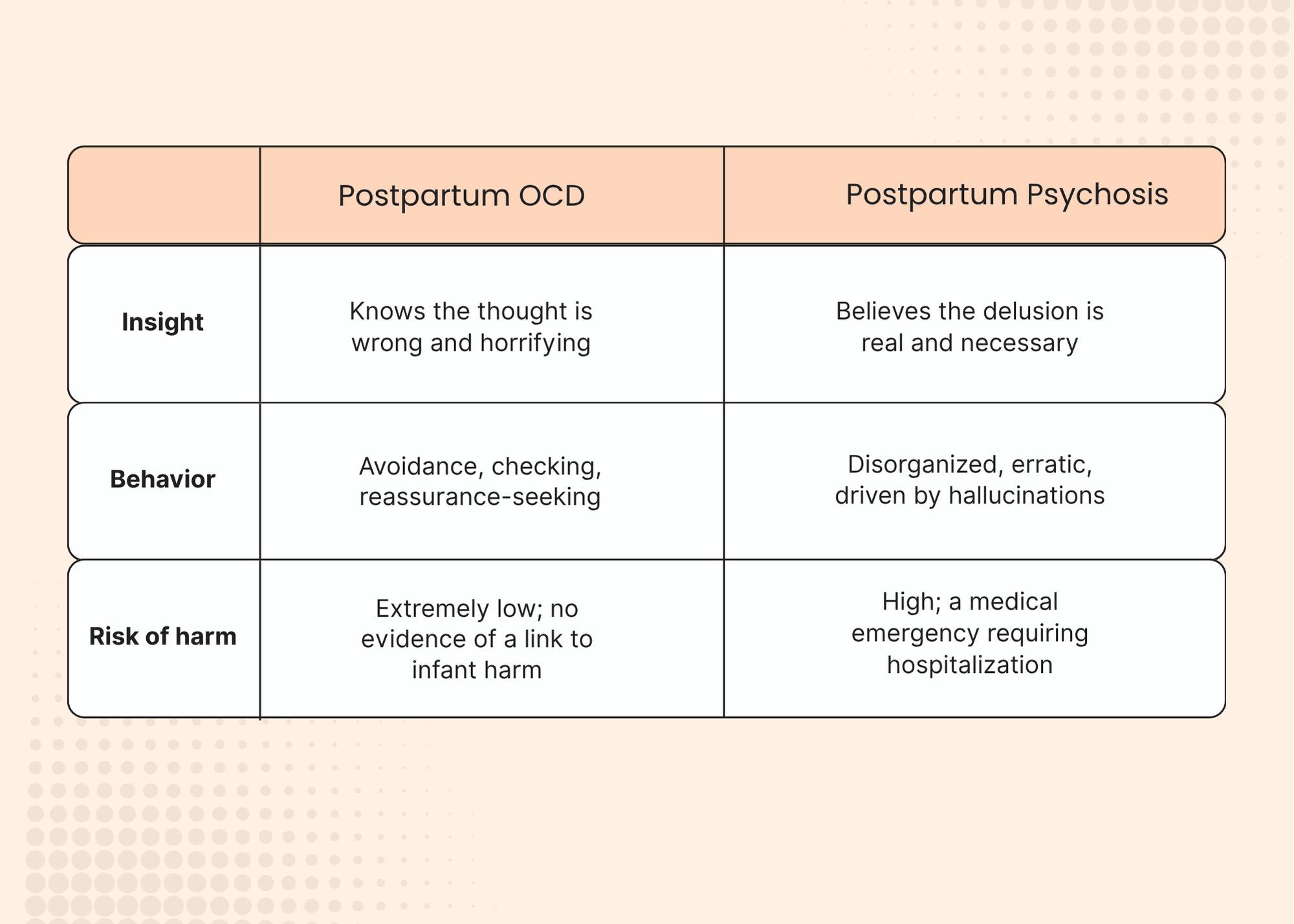
In postpartum OCD, the thought is what clinicians call ego-dystonic: it runs opposite to who this mother is, what she wants, and what she values. Her reality testing is fully intact. She knows the thought is irrational and contrary to who she is. What she can't get is certainty. OCD's whole engine is doubt: it whispers "but what if," and no amount of checking or reassurance ever quiets it for good. That gap, between the thought's horror and its refusal to resolve into certainty, is exactly what produces the anxiety, guilt, and shame that define postpartum OCD.
That distress drives her into exhausting protective behavior: hiding the kitchen knives, refusing to bathe the baby alone, waking up every twenty minutes to check that he's still breathing, asking her partner to stay within arm's reach of the baby. She isn't a danger. She's working overtime, driven by doubt, to make sure of it. There is no evidence linking these ego-dystonic intrusive thoughts to actual harm to an infant.
Postpartum Psychosis: A Break From Reality
Postpartum psychosis is a different disorder entirely, and it's rare, affecting about 1 to 2 out of every 1,000 deliveries. It's also a true psychiatric emergency.
Where postpartum OCD thoughts are ego-dystonic, the beliefs in psychosis are ego-syntonic: the mother believes them. The illness takes her reality testing and her insight along with it, not because of anything she did, but because of what's happening in her brain and body after childbirth. She may become convinced her baby is possessed, defective, or in danger from some outside force, and that she has to act, often experienced by her as protection or rescue rather than harm.
The symptoms can shift fast, sometimes hour to hour: confusion, disorientation, rapid mood swings, and command hallucinations (hearing voices directing her to act). Onset is usually sudden, typically three to fourteen days after birth, and severe sleep deprivation is a major trigger. Popular media loves to paint psychosis as manic euphoria. It's usually not. Irritability is the most common mood symptom (73% of cases), and 41% of women present with a depressive, not manic, psychotic profile, which is why it so often gets missed and treated an average of two weeks later.
Because she cannot accurately evaluate reality or consequences, the risk is real: infanticide occurs in an estimated 1% to 4.5% of postpartum psychosis cases. This is why postpartum psychosis requires immediate inpatient hospitalization, full stop, and here's the part that gets lost in the fear: with fast treatment, the outlook is good. Most mothers recover fully and go on to bond with and raise their children. This is a medical emergency, not a reflection of who she is as a mother.
The Real Difference Isn't the Word, It's the Belief
Unwanted, intrusive thoughts show up across a lot of conditions, not just OCD. PTSD, depression, and anxiety disorders can all involve thoughts that intrude and won't leave. The word "thought" alone was never the tell.
What actually separates postpartum OCD from postpartum psychosis is her relationship to it. In OCD, she recognizes the thought as irrational and fights it. That's ego-dystonic. In psychosis, a delusion isn't recognized as false or fought. It's believed. That's ego-syntonic. That distinction, not which word gets used, is what determines risk, treatment, and how urgently someone needs help, and it's the distinction that matters clinically and legally.
Side-by-Side: What Actually Separates Them
The Danger of Misdiagnosis
Here's the tragic irony. Mothers with postpartum OCD are the ones least likely to hurt their babies, and they're often the most afraid to say anything out loud, because they think a scary thought will be read as a warning sign. So they suffer in silence, sometimes for months.
Mothers experiencing psychosis face a different kind of silence. Impaired insight can keep her from recognizing that anything is wrong, and even when a partner or family member does notice, fear of judgment or of losing the baby can delay getting her to care. Both forms of silence carry real risk, just in different directions.
At the same time, without public understanding of ego-dystonic versus ego-syntonic, a provider unfamiliar with perinatal mental health can misread postpartum OCD as something more dangerous, or miss the early signs of true psychosis because it initially looks like "just anxiety" or sleep deprivation. Either error costs a family. One leads to unnecessary trauma and, in some cases, unwarranted child welfare involvement. The other delays a medical emergency.
This is exactly why an accurate diagnosis matters, and why it needs to come from someone trained specifically in perinatal OCD, not a generic screening tool or a rushed intake question. At Anxiety & OCD Behavioral Health Center in Chesterton and Schererville, our licensed mental health counselors and clinical psychologists specialize in this: distinguishing postpartum OCD from psychosis, and from the other perinatal mood and anxiety disorders that mimic both. Getting the diagnosis right is an essential part of the treatment plan.
Can the Two Overlap?
Rarely, and it's worth naming so the picture stays honest. Severe OCD can occasionally present with absent insight, closely mimicking psychosis, and still respond fully to standard OCD treatment once correctly identified. Emergency presentations sometimes blend OCD-style checking with hallucinations, making an immediate, confident diagnosis genuinely difficult in the moment. And about 10% of mothers hospitalized for postpartum psychosis also report child-related obsessive thoughts alongside their psychotic symptoms. None of this changes the core distinction. That's why the diagnosis needs a specialist, not a guess.
Both Conditions Are Treatable
Postpartum OCD responds to Exposure and Response Prevention (ERP), the gold-standard therapy that trains the brain to sit with the anxious thought without performing the safety behavior, combined with SSRIs, usually at higher doses and for longer than what's used for standard postpartum depression.
Postpartum psychosis needs immediate inpatient care, mood stabilizers and antipsychotics (lithium has the strongest evidence), and in severe cases, ECT. Standard antidepressants alone are avoided because they can trigger a worse manic or mixed state. Aggressively treating sleep loss is part of stabilization, since sleep deprivation is one of the biggest biological triggers for psychosis.
Different disorders. Different treatments. Same starting point: an accurate diagnosis.
If This Is You
If you're pregnant or postpartum and a thought has shown up that scares you, that thought does not mean you'd ever act on it. It makes you a mother whose brain is doing what OCD does to millions of people: attaching horror to the thing you love most. And you are not alone.
If something feels different, if you've lost touch with what's real, if you're hearing things or believe your baby is in danger from a force no one else can see, that's an emergency, and it is not your fault. Postpartum psychosis is a medical crisis, not a character flaw, and it responds well to treatment. You are not alone, and help works fast once it starts. Call 911, go to the nearest ER, or call the Postpartum Support International Helpline at 1-800-944-4773.
What we treat is postpartum OCD. Book a free 30-minute call with Anxiety & OCD Behavioral Health Center at 219.228.7630 and get evaluated by a team that knows the difference.
This piece isn't commentary on Lindsay Clancy's diagnosis, guilt, or innocence; that's for the court to determine. It's general clinical education about two distinct conditions, prompted by her trial putting both in the news.
